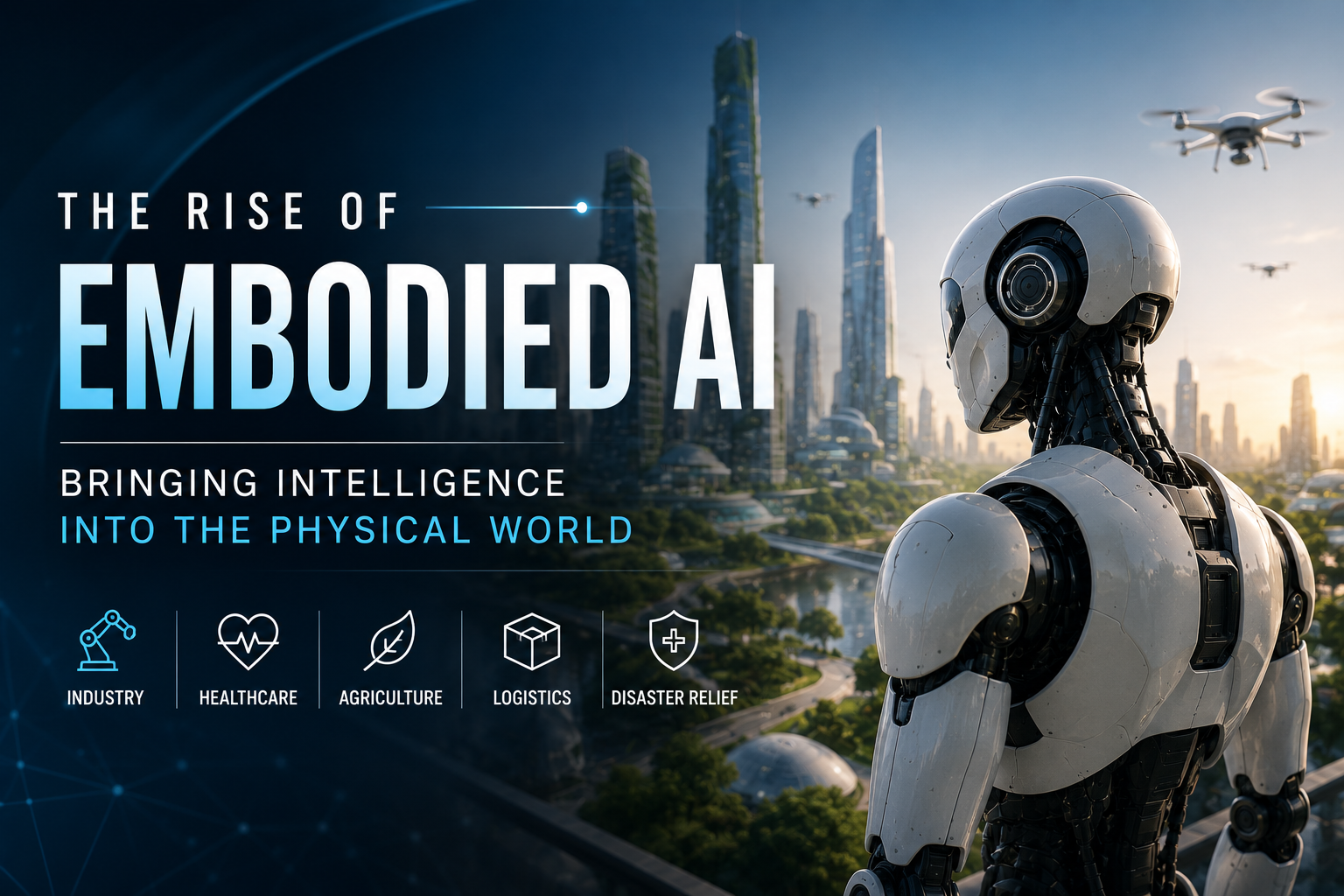
The Rise of Embodied AI: Bringing Intelligence Into the Physical World

Artificial intelligence is entering a new phase of evolution known as embodied or physical AI, where intelligent systems are no longer limited to digital environments but are increasingly capable of interacting with the real world through robots, autonomous machines, drones, and smart industrial systems. Recent developments from companies such as NVIDIA, Tesla, XPeng, UBTech, Figure AI, and DeepMind demonstrate how AI is rapidly moving beyond chatbots and software agents toward machines that can perceive, reason, learn, and act autonomously in dynamic physical environments. China has emerged as a major global leader in this transformation, heavily investing in humanoid robotics, autonomous manufacturing, and AI-powered industrial systems through strong government support and large-scale industrial infrastructure. Chinese companies such as UBTech and XPeng are already deploying humanoid robots in factories, logistics centers, and experimental real-world environments powered by advanced multimodal AI systems like DeepSeek R1. Meanwhile, global technology leaders including NVIDIA are accelerating the ecosystem with platforms such as Isaac Sim, Omniverse, Cosmos, and Project GR00T, enabling robots to train in simulated environments before deployment in the real world. Experts believe embodied AI could revolutionize industries including healthcare, manufacturing, warehousing, logistics, autonomous transportation, and eldercare by improving productivity, reducing labor shortages, and enabling adaptive automation at unprecedented scale. However, challenges related to cost, safety, energy consumption, workforce disruption, and regulatory oversight continue to limit widespread deployment. Analysts also warn that the global race for embodied AI is becoming increasingly geopolitical, with China and the United States competing for technological leadership in what many consider the next frontier of artificial intelligence. As advances in robotics, multimodal reasoning, edge computing, and world models continue accelerating, embodied AI is expected to become one of the defining technological transformations of the next decade, fundamentally changing how humans and intelligent machines interact in the physical world.
The next generation of AI will not just think—it will move, interact, and exist in the physical world.
What is Embodied AI
Embodied AI, also known as physical AI, refers to artificial intelligence systems integrated into physical machines that can perceive, understand, and interact with the real world autonomously. Unlike traditional AI systems that operate only in digital environments, embodied AI combines sensors, robotics, multimodal reasoning, and machine learning to enable machines to make decisions and perform actions in dynamic physical spaces. These systems can exist in various forms, including humanoid robots, autonomous vehicles, drones, industrial robots, and smart machines. Embodied AI relies on technologies such as computer vision, tactile sensing, spatial computing, and vision-language-action models to interpret surroundings, learn from experience, and adapt to changing environments in real time. Experts believe embodied AI represents the next major evolution of artificial intelligence because it bridges the gap between digital intelligence and real-world action. As the technology advances, embodied AI is expected to transform industries such as manufacturing, healthcare, logistics, transportation, and smart automation worldwide.
- Physical interaction with environments
- Real-world perception and movement
- Learning through sensory feedback
- Autonomous decision-making
- Human-robot collaboration
How Humanoid Robots Work
Humanoid robots operate through a combination of artificial intelligence, advanced sensors, robotics hardware, and real-time data processing systems that allow them to interact with physical environments in a human-like manner. These robots are equipped with cameras, microphones, tactile sensors, motion systems, and AI-powered processors that help them perceive surroundings, recognize objects, interpret commands, and make autonomous decisions. Modern humanoid robots rely heavily on multimodal AI models, including vision-language-action systems, which combine computer vision, natural language understanding, and motor control to coordinate movement and task execution. They also use reinforcement learning and simulation-based training to improve performance through repeated interactions with virtual and real-world environments. Advanced onboard computing systems and edge AI processors enable these robots to process information and respond instantly without depending entirely on cloud infrastructure. As technology continues evolving, humanoid robots are becoming increasingly capable of performing tasks
- Environmental perception
- AI-based reasoning
- Motion planning
- Physical execution
- Continuous learning & adaptation
Real-World Applications

Embodied AI and humanoid robotics are increasingly being applied across industries where automation, adaptability, and real-time decision-making are becoming essential. In manufacturing, AI-powered robots are being used for assembly, quality inspection, material handling, and autonomous production line operations. Chinese companies such as UBTech and XPeng are already deploying humanoid robots in factories and industrial environments to perform repetitive and physically demanding tasks. In logistics and warehousing, autonomous robots and drones help manage inventory, transport goods, and optimize supply chain operations. Healthcare organizations are exploring embodied AI for surgical assistance, patient care, rehabilitation, and elderly support systems, particularly in countries facing aging populations. Additionally, physical AI is being integrated into autonomous vehicles, smart homes, customer service systems, and industrial maintenance operations.
- Manufacturing & warehouse automation
- Healthcare assistance & elderly care
- Logistics & delivery systems
- Retail & customer service
- Space exploration & hazardous environments
Why Embodied AI Matters
Embodied AI matters because it represents the next major evolution of artificial intelligence, enabling machines to move beyond digital tasks and interact directly with the physical world. Unlike traditional AI systems that primarily process information or generate content, embodied AI combines perception, reasoning, and physical action to perform real-world tasks autonomously. This technology has the potential to transform industries such as manufacturing, healthcare, logistics, transportation, and eldercare by improving productivity, reducing labor shortages, and enabling intelligent automation at large scale. Experts believe embodied AI can enhance human-machine collaboration by allowing robots and autonomous systems to learn from human behavior, adapt to changing environments, and operate safely alongside people. Governments and enterprises are also viewing embodied AI as a strategic technology tied to economic competitiveness, industrial modernization, and future technological leadership. As advancements in robotics, edge computing, and multimodal AI continue accelerating, embodied AI is expected to play a defining role in the future of global innovation and automation.
- Expands AI beyond software
- Enhances human-machine interaction
- Automates physical labor
- Enables autonomous systems
- Creates adaptive real-world intelligence
Embodied AI gives machines the ability not only to understand the world—but to exist within it.
Challenges & Limitations
Despite rapid advancements, embodied AI and humanoid robotics still face several technical, economic, and societal challenges that limit large-scale adoption. One major limitation is the difficulty of enabling robots to operate safely and reliably in unpredictable real-world environments. While AI systems perform well in simulations, transferring those capabilities into physical spaces remains highly complex due to issues involving movement precision, object handling, environmental variability, and real-time decision-making. High development costs, expensive hardware components, energy consumption, and reliance on advanced AI chips also continue to restrict widespread commercial deployment. Experts further warn about risks related to cybersecurity, workplace disruption, job displacement, data privacy, and the ethical use of autonomous systems. Additionally, many humanoid robots still lack human-level dexterity, adaptability, and contextual understanding, making them suitable only for limited industrial or controlled environments. As embodied AI evolves, stronger regulation, improved safety standards, and responsible governance will be essential for sustainable and trustworthy deployment.
- High hardware costs
- Limited adaptability in complex environments
- Energy and battery limitations
- Safety and reliability concerns
- Ethical implications of autonomous machines
The Future of Embodied AI

The future of embodied AI is expected to reshape how humans interact with machines by enabling intelligent systems to operate autonomously in real-world environments. Advances in robotics, multimodal AI, edge computing, vision-language-action models, and simulation technologies are rapidly improving the capabilities of humanoid robots, autonomous vehicles, drones, and industrial automation systems. Experts predict that embodied AI will play a major role in manufacturing, healthcare, logistics, transportation, eldercare, defense, and smart infrastructure by improving efficiency, reducing labor shortages, and supporting adaptive human-machine collaboration. Countries such as China and the United States are increasingly viewing embodied AI as a strategic technology linked to economic competitiveness, industrial leadership, and future AI dominance. At the same time, future development will require stronger governance frameworks, safety standards, and ethical oversight to address concerns related to workforce disruption, security, and responsible deployment. As technology matures, embodied AI is expected to become a defining force in the next era of global digital transformation.
- Autonomous household robots
- AI-powered healthcare assistants
- Smart industrial workforces
- Human-robot collaboration ecosystems