The Rise of Collaborative AI
The rise of Collaborative AI marks a significant shift in the evolution of artificial intelligence, moving from isolated intelligent models to interconnected systems of multiple AI agents working together toward common goals. Traditional AI systems often operate independently and face limitations when dealing with complex, dynamic, and large-scale problems. In contrast, Collaborative AI leverages Multi-Agent Systems (MAS), where intelligent agents communicate, coordinate, and share information to make faster and more accurate decisions. This collaborative approach combines human-like teamwork with the speed, scalability, and analytical capabilities of artificial intelligence, enabling organizations to automate complex tasks, improve operational efficiency, and respond proactively to changing environments. In domains such as cybersecurity, healthcare, finance, and automation, Collaborative AI enhances adaptability and resilience by allowing agents to continuously learn, distribute workloads, and solve problems collectively rather than individually. As digital ecosystems become more interconnected and data-driven, Collaborative AI is emerging as a transformative technology that supports intelligent decision-making, scalable automation, and real-time problem-solving. By integrating distributed intelligence with continuous communication and cooperation, Collaborative AI is redefining how modern systems operate, creating smarter, more efficient, and future-ready solutions capable of addressing increasingly sophisticated challenges across industries.
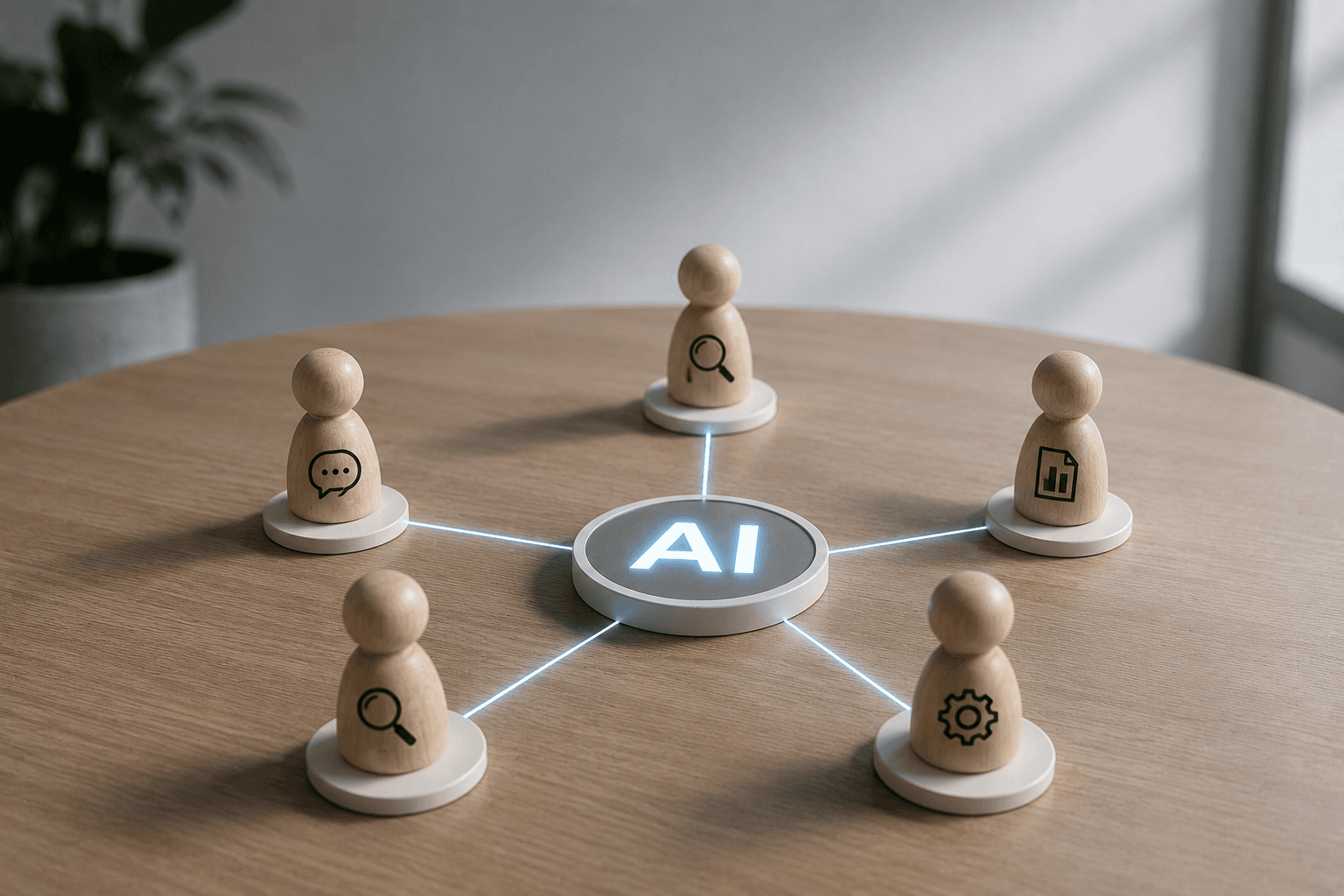
The future of AI is not a single genius—it’s a team of specialists.
What Are Multi-Agent Systems?
A multi-agent AI system is composed of multiple intelligent agents that operate independently while collaborating efficiently to analyze user requests, make informed decisions, and execute tasks toward achieving a shared objective.
These systems are designed to handle complex, large-scale, and multi-step challenges by distributing responsibilities among different agents, allowing organizations and teams to concentrate on more strategic and high-value activities.
Some common business applications of multi-agent systems include:
Customer Support:
Multiple AI agents can coordinate to understand customer concerns, provide troubleshooting solutions, escalate unresolved issues, and process refunds or billing adjustments seamlessly.
Supply Chain Management:
Intelligent agents representing suppliers, warehouses, and logistics networks can collaborate in real time to forecast demand, optimize inventory levels, allocate resources, and streamline operations efficiently.
Cybersecurity and Fraud Prevention:
AI agents can continuously monitor suspicious activities, evaluate potential threats, detect fraudulent behavior, and automatically adapt security measures to minimize organizational risks.
- Autonomous decision-making
- Communication between agents
- Shared or individual goals
- Distributed problem-solving
Traditional AI systems struggle when dealing with complex, multi-step, or dynamic problems. A single model often becomes a bottleneck due to limited scalability and lack of specialization.
- Limited scalability
- Sequential execution
- Single point of failure
- Reduced adaptability
How Multi-Agent Systems Work
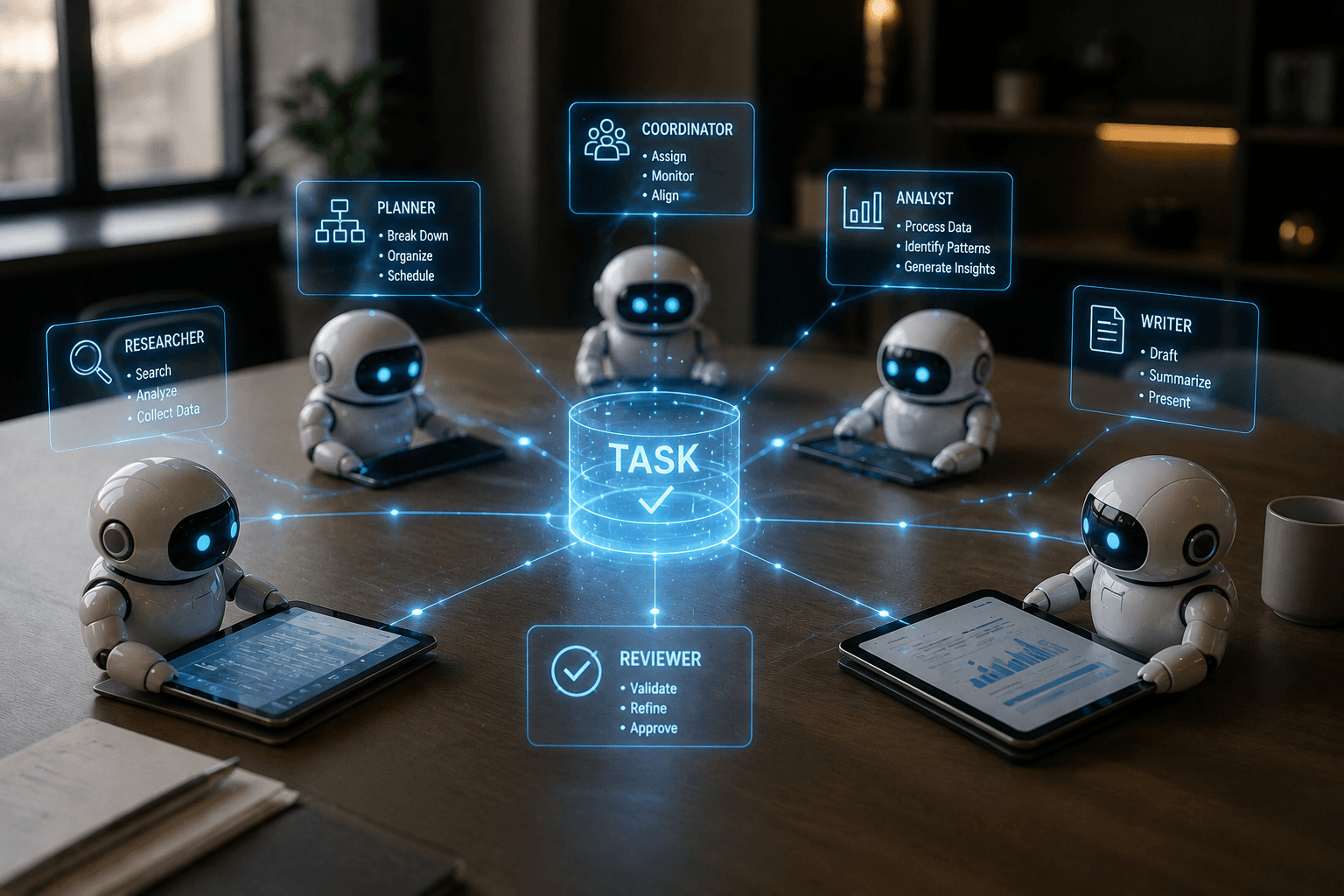
Multi-agent systems function as a coordinated loop where each agent continuously interacts with its environment and other agents to accomplish tasks efficiently. The process begins with perception, where agents gather relevant data—this could be user inputs, sensor data, APIs, or outputs from other agents. Next comes reasoning, where the agent analyzes this information using logic, rules, or advanced models like LLMs to decide what should be done. Once a decision is made, agents move into the communication phase, exchanging insights, results, or instructions with other agents to ensure alignment and avoid conflicts. Finally, in the action phase, agents execute tasks such as generating outputs, triggering workflows, updating systems, or making decisions. This cycle repeats dynamically, allowing the system to adapt in real-time, improve outcomes through collaboration, and handle complex, multi-step problems more effectively than a single-agent system.
- Perception – Collecting data from the environment
- Reasoning – Processing using AI/LLMs
- Communication – Sharing insights with other agents
- Action – Executing tasks
Architecture of Multi-Agent Systems
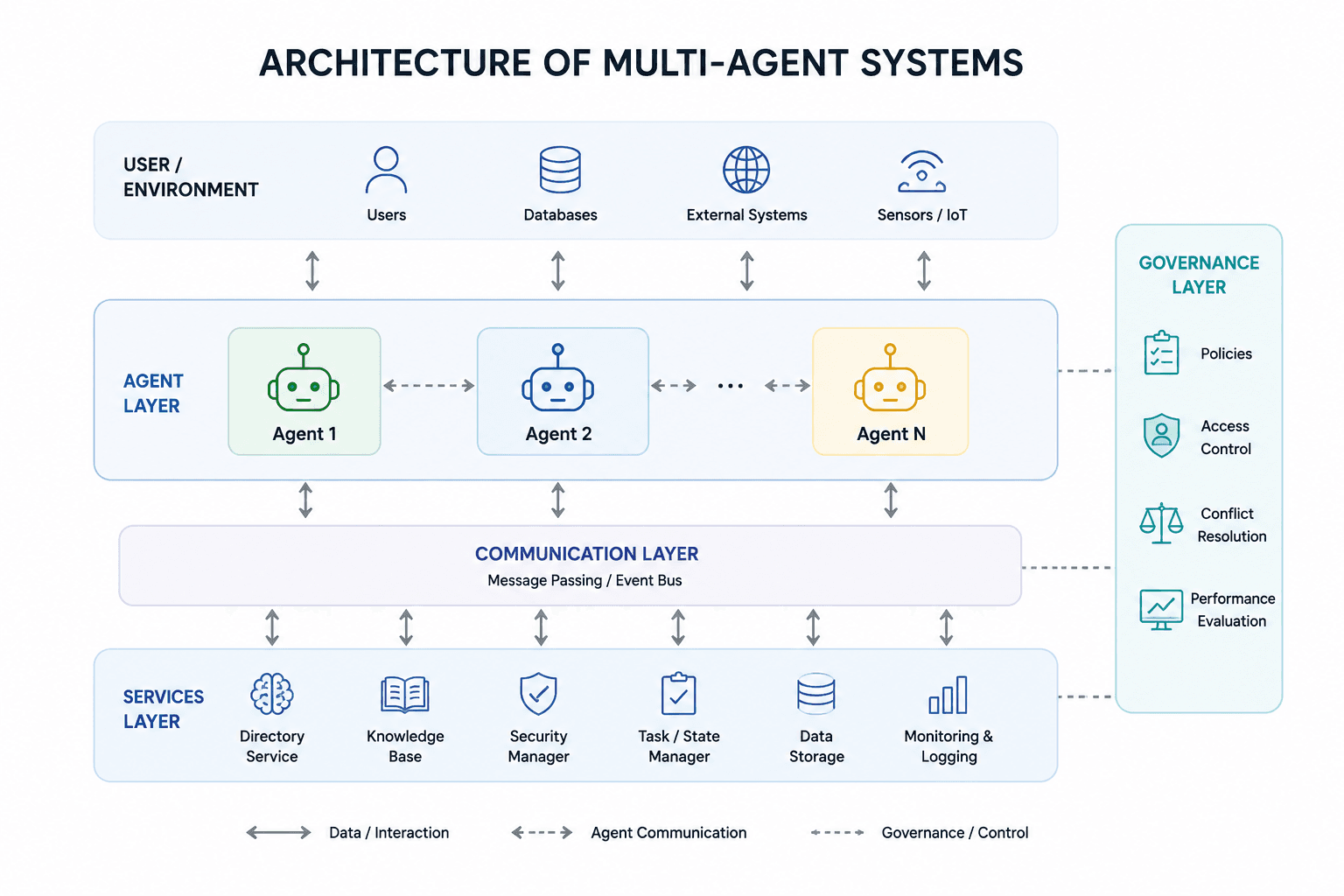
A multi-agent system is not just a collection of independent agents—it is a structured architecture where each component plays a specific role to ensure smooth coordination and efficient execution. At the core are the agents themselves, but their effectiveness depends on how well they are connected through the system. The environment provides the context in which agents operate, including data sources, user inputs, and external systems. The communication layer acts as the backbone, enabling agents to exchange information, delegate tasks, and stay aligned with shared goals. Overseeing all of this is the task manager or orchestrator, which assigns responsibilities, manages workflows, resolves conflicts, and ensures that the overall objective is achieved without redundancy or inefficiency. Together, these interconnected components create a cohesive system where multiple agents can collaborate seamlessly, adapt to changing conditions, and solve complex problems in a structured and scalable way.
- Agents (LLM-powered or rule-based)
- Environment
- Communication Layer
- Task Manager / Orchestrator
Real-World Applications
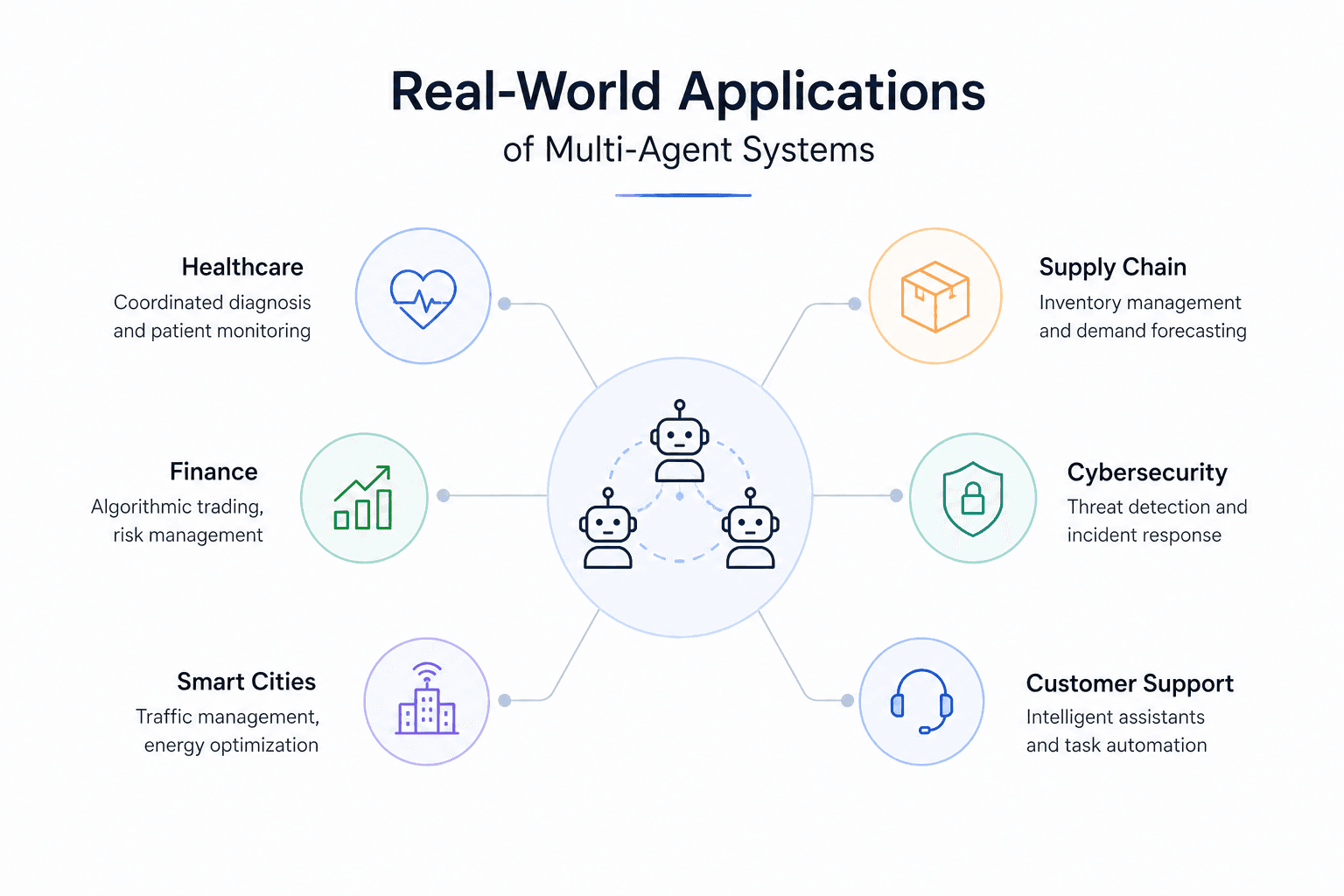
Multi-agent systems are no longer just theoretical concepts—they are actively being deployed across industries to handle complex, real-world problems that require coordination, speed, and intelligent decision-making. Instead of relying on a single AI model, organizations use multiple specialized agents that collaborate to optimize different parts of a workflow. For example, in healthcare, one agent may analyze patient data while another suggests treatments; in supply chains, different agents handle demand forecasting, inventory management, and route optimization simultaneously. This division of responsibilities allows systems to operate more efficiently, adapt to changing conditions, and deliver faster, more accurate results. As industries become more data-driven and interconnected, multi-agent systems are proving to be a powerful approach for building scalable, intelligent, and autonomous solutions.
- Healthcare: Diagnosis & monitoring
- Supply Chain: Logistics optimization
- Finance: Algorithmic trading
- Customer Support: Automated responses
- Smart Cities: Traffic & energy optimization
Multi-agent systems transform intelligence into collaboration at scale
Single-Agent vs Multi-Agent Systems
| Feature | Single-Agent | Multi-Agent |
|---|---|---|
| Scalability | Low | High |
| Speed | Sequential | Parallel |
| Accuracy | Moderate | High |
| Flexibility | Limited | High |
The Future of Multi-Agent AI
The future of AI lies in agent ecosystems, where multiple AI systems collaborate seamlessly. Organizations are moving toward AI teams instead of single models, enabling smarter automation and decision-making. These systems will evolve into self-organizing networks that can dynamically assign roles and optimize workflows in real time. As coordination improves, businesses will achieve higher efficiency, reduced operational costs, and faster innovation cycles. Ultimately, multi-agent ecosystems will redefine how work is structured, shifting from human-led processes to hybrid human–AI collaboration at scale.
- Autonomous enterprises
- AI research teams
- Smart digital workforces
- Self-optimizing systems