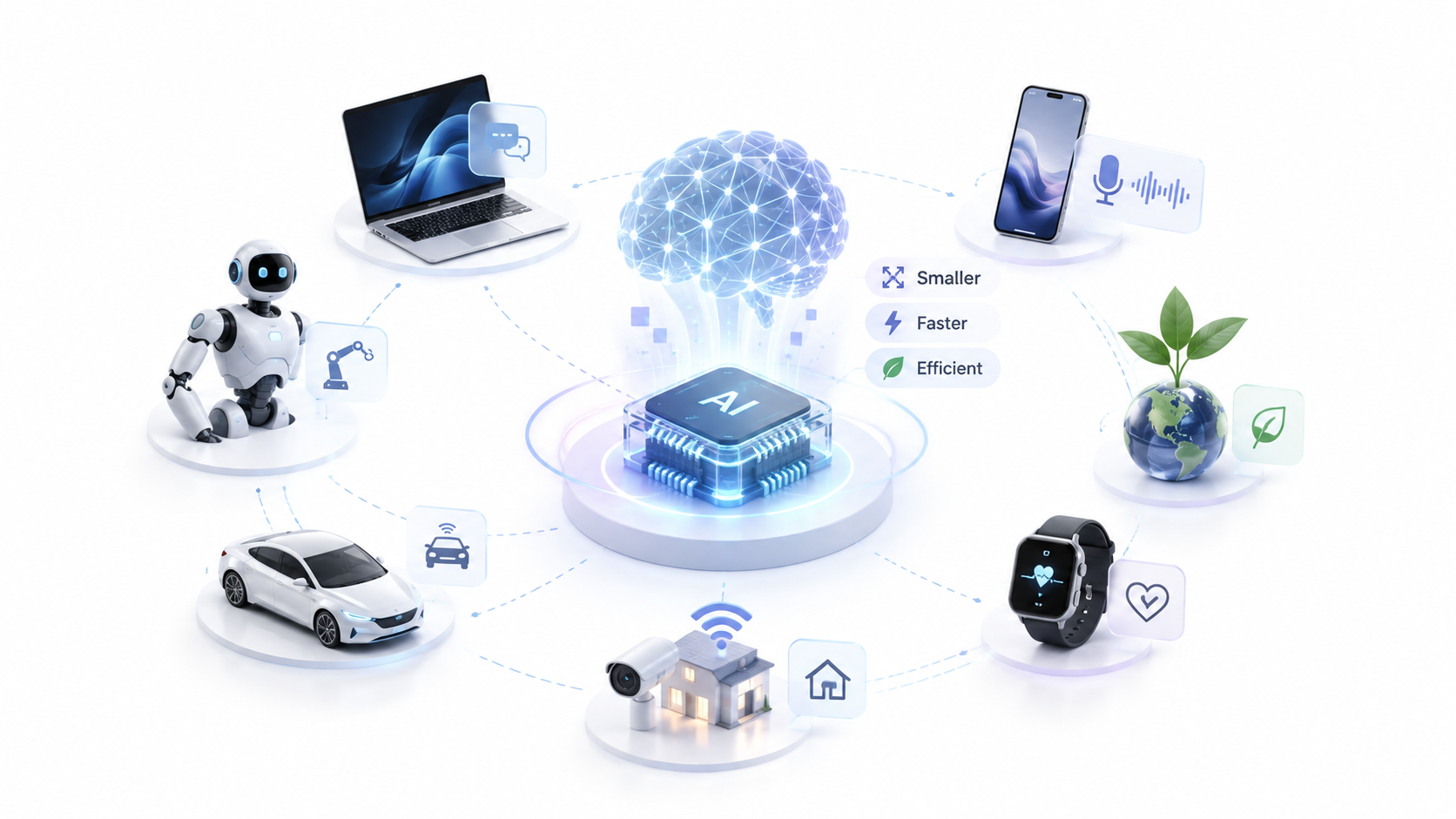

The future of AI may not belong only to the biggest models—it may also belong to the smartest and most efficient ones.
What Are Small / Efficient AI Models?
Small or efficient AI models are artificial intelligence systems designed to perform useful tasks while requiring fewer computational resources than large-scale AI models.
Traditional large AI models can contain billions or even trillions of parameters and often require powerful data centers and specialized hardware. Small AI models, on the other hand, are designed to reduce model size, memory usage, energy consumption, and processing requirements.
The goal is not simply to make AI smaller. The goal is to achieve the best possible performance using the least amount of computational resources.
Efficient models can be created through several techniques, including model compression, quantization, pruning, knowledge distillation, and optimized model architectures.
These models make it possible to deploy AI in environments where large cloud-based models may be too expensive, slow, or impractical.
- Smaller model size
- Faster response times
- Lower memory requirements
- Reduced energy consumption
- Lower deployment costs
- Better suitability for edge devices
Why Do We Need Smaller AI Models?
The rapid growth of large AI models has created several challenges. Training and running massive models can require expensive GPUs, large amounts of electricity, advanced cooling systems, and powerful cloud infrastructure.
For many applications, using a huge AI model may not even be necessary.
For example, a smartphone voice assistant, a spam detection system, or an image recognition application may only need to perform a specific task efficiently. Running a massive model for such applications could increase costs and slow down performance.
Small AI models solve this problem by providing AI capabilities that are optimized for specific use cases.
They allow organizations to deploy artificial intelligence without always depending on expensive cloud infrastructure.
Key Benefits of Smaller Models
- Lower infrastructure costs
- Faster AI inference
- Reduced latency
- Better privacy through local processing
- Lower energy consumption
- Easier deployment on consumer devices
Efficient AI focuses on doing more with less.
How Are AI Models Made More Efficient?

AI engineers use several techniques to reduce the size and computational requirements of machine learning models. One of the most common techniques is quantization, which reduces the precision used to store and process the parameters of an AI model. By using lower-precision numerical formats, developers can reduce memory requirements and improve processing speed without significantly affecting the model's performance.
Another important technique is pruning. Large neural networks often contain connections and parameters that contribute very little to the final output. Pruning identifies and removes these unnecessary components, reducing the complexity of the model and making it faster and more efficient.
Knowledge distillation is another powerful approach to creating smaller AI models. In this process, a large and powerful model acts as a teacher, while a smaller model acts as a student. The smaller model learns from the knowledge and outputs of the larger model, allowing it to achieve strong performance while requiring significantly fewer computational resources.
Researchers are also developing more efficient AI architectures. Instead of simply increasing the number of parameters in a model, modern AI research increasingly focuses on designing architectures that can perform complex tasks more intelligently and efficiently.
Another important approach is the development of specialized models. Rather than creating one massive model that attempts to perform every possible task, developers can build smaller models optimized for specific applications such as speech recognition, image classification, document analysis, customer support, or coding assistance. These specialized models can often deliver excellent results while consuming far fewer resources.
Where Are Small AI Models Used?
Small and efficient AI models are becoming increasingly important across many industries and technologies. They are particularly useful in situations where applications require fast responses, low latency, lower costs, offline functionality, or improved privacy.
Modern smartphones already use AI for features such as voice recognition, camera enhancement, image processing, translation, text prediction, and personal assistants. Efficient AI models make it possible for many of these tasks to run directly on the device rather than sending all information to a cloud server. This can improve response speed while also reducing privacy concerns.
Small AI models are also playing an important role in Edge AI. Edge AI refers to running artificial intelligence closer to where data is generated. Instead of continuously sending information to distant cloud servers, AI processing can happen directly on devices such as cameras, sensors, robots, and industrial machines. This allows systems to make decisions faster, reduce network dependency, improve privacy, and minimize latency.
In healthcare, efficient AI models can support applications involving medical imaging, wearable devices, patient monitoring, and healthcare analytics. Smaller models can be particularly valuable in environments where computing resources are limited or where fast processing is required.
Robots, drones, and autonomous systems also benefit significantly from efficient AI. These machines often need to make decisions in real time, and sending every piece of information to a cloud server could introduce delays. Small AI models allow these systems to process information locally and respond quickly to changing environments.
Businesses can also use efficient AI models for applications such as customer support automation, document processing, fraud detection, recommendation systems, data classification, and workflow automation. By using smaller and specialized models, organizations can reduce operational costs while still benefiting from artificial intelligence.
Small Models vs Large Models
Small and large AI models both have important roles in the future of artificial intelligence. Large models are generally better suited for highly complex reasoning, broad general-purpose capabilities, and tasks that require access to large amounts of knowledge. However, these capabilities often come with higher computational requirements and infrastructure costs.
Small AI models are particularly useful when speed, efficiency, privacy, and affordability are more important. They can provide faster inference, require less hardware, consume less energy, and operate on edge devices such as smartphones, laptops, sensors, and robots.
The future of AI will likely involve a combination of both approaches. Large models may continue to handle highly complex tasks in powerful cloud environments, while smaller and specialized models perform faster tasks directly on local devices. Instead of one type of model replacing the other, AI systems may increasingly use the right model for the right task.
Why Efficient AI Matters
Efficient AI is becoming increasingly important because artificial intelligence is expanding into billions of devices worldwide. Running massive models for every application would require enormous amounts of computing power, energy, and infrastructure. As AI adoption continues to grow, efficiency will become essential for making these technologies sustainable and affordable.
Small and efficient models can help reduce operational costs and energy consumption while making AI technology accessible to a larger number of businesses and developers. They can also improve privacy by allowing sensitive information to be processed locally instead of being constantly transmitted to cloud servers.
Efficient AI can therefore contribute to faster applications, lower infrastructure costs, reduced environmental impact, improved privacy, and wider adoption of artificial intelligence. It represents an important step toward making powerful AI available not only to major technology companies but also to smaller organizations and individual users.
The goal of AI innovation is not just to build more powerful models—but to build intelligence that can be used efficiently everywhere.
Challenges and Limitations
Despite their many advantages, small AI models also have certain limitations. Reducing the size of a model can sometimes affect its accuracy or its ability to handle highly complex tasks. Smaller models generally have less capacity than massive AI systems, which can limit their performance in areas requiring advanced reasoning or broad knowledge.
Developers must therefore carefully balance efficiency and performance. A model that is heavily compressed may become faster and smaller, but excessive optimization can reduce its capabilities. Finding the right balance between model size, speed, accuracy, and resource consumption remains one of the major challenges in efficient AI development.
Hardware compatibility can also be a challenge. Different devices have different processing capabilities, memory limitations, and AI acceleration technologies. Developers must optimize models carefully to ensure they perform effectively across different platforms.
The Future of Small and Efficient AI Models
The future of artificial intelligence is likely to become more diverse and decentralized. Instead of relying only on massive centralized AI systems, we may see a combination of powerful cloud models, smaller specialized models, and AI systems running directly on personal devices.
Advancements in AI hardware, model optimization, edge computing, and efficient architectures will continue making powerful AI accessible on smaller devices. Future smartphones may include more advanced AI assistants that operate locally, while robots and IoT devices may use onboard intelligence to make decisions without depending entirely on cloud infrastructure.
We may also see more personalized AI systems that operate directly on individual devices, offline AI applications that work without constant internet connectivity, and specialized models designed for particular industries and business requirements.
As AI adoption continues to grow, efficiency will become just as important as intelligence. The companies and developers who can build AI systems that are powerful, affordable, fast, and energy-efficient will play an important role in shaping the next generation of technology.
Conclusion
Small and efficient AI models represent an important shift in the evolution of artificial intelligence. For many years, AI development focused heavily on building larger and more powerful models. Today, the industry is increasingly recognizing that bigger is not always better and that efficiency plays an equally important role.
Smaller models can provide faster performance, lower costs, improved privacy, reduced energy consumption, and wider accessibility. They make it possible to bring artificial intelligence to smartphones, robots, IoT devices, businesses, and countless everyday applications.
The future of AI will not be defined only by how large models become. It will also be defined by how efficiently intelligence can be delivered to the devices and people who need it.
Smaller models. Faster decisions. Lower costs. Smarter technology.