The Agentic AI Reality Check: From Hype to Practical Transformation

Agentic AI has rapidly emerged as one of the most discussed technology trends of 2025 and 2026, promising a future where autonomous AI agents can independently plan, reason, and execute complex business tasks. Major technology companies including IBM, Deloitte, Siemens, and Gartner predict that AI agents will increasingly reshape enterprise operations, workflow automation, and industrial productivity. However, recent industry reports reveal a growing “agentic reality gap” between ambitious expectations and real-world implementation challenges. While organizations worldwide are heavily investing in AI agents, many projects remain stuck in pilot stages due to legacy infrastructure limitations, poor data quality, governance concerns, unclear ROI, and lack of organizational readiness. Experts emphasize that businesses often fail by attempting to automate outdated workflows instead of redesigning operations specifically for agent-native environments. At the same time, concerns around transparency, compliance, hallucinations, cybersecurity, and uncontrolled autonomous decision-making continue to raise serious questions about trust and accountability. Despite these challenges, practical adoption is already accelerating across industries such as manufacturing, finance, supply chain management, and automation engineering. Siemens recently introduced its Eigen Engineering Agent, capable of autonomously executing industrial engineering tasks with significantly improved efficiency and accuracy. In India, manufacturers are increasingly adopting smaller edge-based AI models instead of expensive cloud-heavy systems, prioritizing cost-efficiency, resilience, and real-time operational control. Industry leaders now believe the future of agentic AI will focus less on replacing humans entirely and more on augmenting human expertise through intelligent automation, hybrid governance, and collaborative human-AI workflows. As enterprises continue experimenting with autonomous agents, the long-term success of agentic AI will depend on responsible implementation, scalable infrastructure, transparent governance, and the ability to balance automation with human oversight in increasingly AI-driven workplaces.
Agentic AI is not just about intelligence—it’s about autonomous decision-making.
What is Agentic AI?
Agentic AI refers to AI systems designed to operate with a degree of autonomy. Unlike traditional AI models that simply respond to prompts, agentic systems can plan tasks, use tools, interact with environments, and pursue goals over multiple steps. These systems often combine Large Language Models (LLMs), memory systems, reasoning frameworks, and external tools to simulate independent problem-solving.
- Goal-oriented behavior
- Autonomous task execution
- Decision-making capabilities
- Tool usage & API integration
- Multi-step reasoning
How Agentic AI Works

Agentic AI systems operate through a continuous feedback loop where they perceive information, analyze objectives, plan actions, and execute tasks. The system first interprets a goal, then breaks it into smaller subtasks. Using reasoning models and external tools such as databases, APIs, or search engines, the agent evaluates possible actions and carries them out. After execution, it reviews outcomes, adapts its strategy, and continues working until the objective is achieved or human intervention is required.
- Goal understanding
- Task planning
- Tool selection
- Execution & monitoring
- Feedback & adaptation
Where Agentic AI Is Already Being Used

Agentic AI is already being deployed across several industries where intelligent automation, real-time decision-making, and workflow optimization are becoming critical business priorities. Manufacturing companies are using AI agents for predictive maintenance, quality control, supply chain optimization, and industrial automation. Siemens, for example, introduced the Eigen Engineering Agent to autonomously handle engineering tasks such as PLC coding, device configuration, and HMI visualization. Financial institutions are implementing agentic AI for fraud detection, customer onboarding, compliance monitoring, and risk analysis, while enterprises like Barclays are combining AI agents with human oversight for complex financial processes. Businesses are also integrating AI agents into customer support, enterprise operations, logistics, and data analytics to automate repetitive workflows and improve operational efficiency. In India, manufacturers are increasingly adopting edge-based AI systems powered by smaller language models to support localized, real-time factory operations. As organizations continue modernizing digital infrastructure, agentic AI adoption is steadily expanding across global industries.
- AI coding assistants
- Automated customer support systems
- Business workflow automation
- AI research assistants
- Autonomous e-commerce agents
The Promise of Agentic AI
Agentic AI represents the next major evolution of artificial intelligence by enabling systems to independently plan, reason, and execute tasks with minimal human intervention. Unlike traditional AI assistants that primarily respond to prompts, agentic AI systems are designed to manage multi-step workflows, interact with other systems, and make context-aware decisions autonomously. Industry leaders such as Deloitte, IBM, and Siemens believe that agentic AI has the potential to significantly improve productivity, operational efficiency, and business scalability across sectors including manufacturing, finance, logistics, healthcare, and enterprise automation. These intelligent agents can automate repetitive workflows, accelerate decision-making, reduce operational costs, and allow employees to focus on higher-value strategic tasks. In industrial environments, agentic AI is already helping engineers optimize processes, monitor systems in real time, and improve workflow efficiency. As organizations continue investing in digital transformation, agentic AI is expected to become a foundational technology for future enterprise operations and intelligent automation.
- Faster task execution
- Continuous automation
- Increased productivity
- Adaptive workflows
- Human-AI collaboration
The vision of agentic AI is a world where software does not just respond—but acts.
The Reality Check: Current Limitations
Despite the growing excitement surrounding agentic AI, current implementations still face several practical and technical limitations that prevent large-scale autonomous deployment. Industry reports from Deloitte, IBM, and other enterprise studies reveal that many organizations struggle to move beyond pilot projects due to challenges related to legacy infrastructure, fragmented data systems, governance gaps, and unclear return on investment. AI agents often depend heavily on high-quality real-time data, modern APIs, and stable digital architectures, which many enterprises still lack. Additionally, concerns regarding hallucinations, inaccurate outputs, poor contextual understanding, cybersecurity risks, and lack of transparency continue to limit trust in autonomous AI systems. Experts also warn that many so-called “agentic” solutions are merely rebranded automation tools with limited reasoning capabilities. As a result, organizations are increasingly recognizing that successful agentic AI adoption requires careful governance, process redesign, human oversight, and gradual implementation rather than unrealistic expectations of full autonomy.
- Inconsistent reasoning
- Hallucinations & factual errors
- Limited long-term memory
- Poor handling of unexpected situations
- Dependence on human oversight
Risks & Concerns
While agentic AI offers significant potential for automation and operational efficiency, it also introduces serious risks and concerns that organizations must address carefully. One of the primary concerns is the lack of transparency in autonomous decision-making, making it difficult to trace how AI agents arrive at specific actions or conclusions. Experts warn that poorly governed AI agents may generate inaccurate outputs, hallucinations, security vulnerabilities, or unintended actions that could disrupt business operations. Additional risks include data privacy violations, cybersecurity threats, compliance failures, and overdependence on AI systems without sufficient human oversight. Enterprises also face challenges related to integrating AI agents with legacy infrastructure, maintaining auditability, and preventing “agent washing,” where basic automation tools are falsely marketed as advanced autonomous systems. Furthermore, experts emphasize that AI agents still lack human judgment, contextual understanding, and ethical reasoning, making human supervision essential for responsible and secure deployment in real-world environments.
- Security vulnerabilities
- Uncontrolled decision-making
- Privacy risks
- Bias in automated actions
- Lack of accountability
The Technology Behind Agentic AI

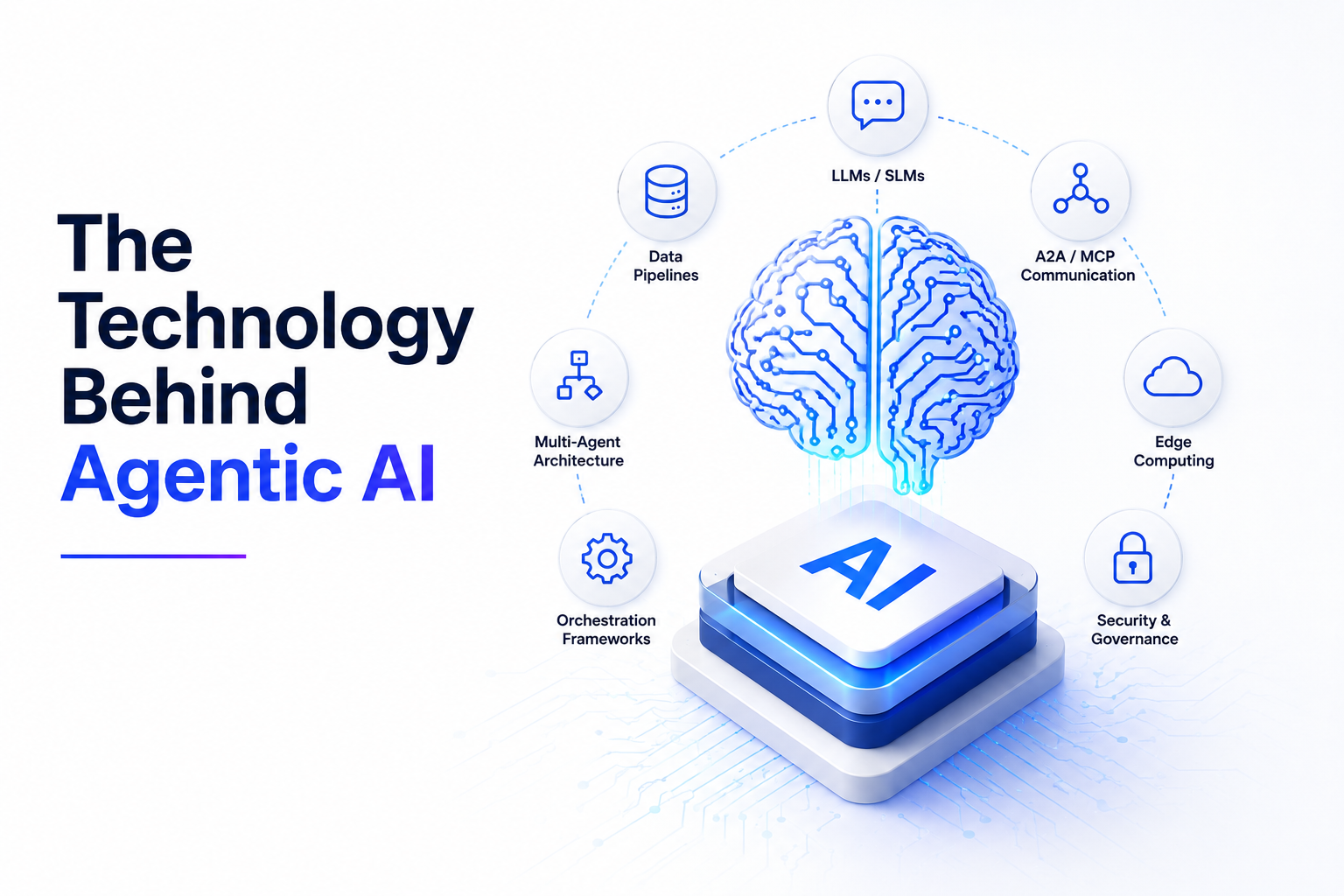
Agentic AI is powered by a combination of advanced technologies that enable artificial intelligence systems to reason, plan, communicate, and execute tasks autonomously. At the core of these systems are large language models (LLMs) and increasingly smaller, specialized language models that can understand context, generate responses, and interact with software tools through APIs. Modern agentic systems also rely on multi-agent architectures, orchestration frameworks, knowledge graphs, real-time data pipelines, and reasoning mechanisms that allow multiple AI agents to collaborate on complex workflows. Technologies such as Model Context Protocol (MCP), Agent-to-Agent (A2A) communication, and orchestration platforms are helping AI agents interact securely across enterprise systems and digital environments. In industrial and enterprise settings, edge computing and Small Language Models (SLMs) are increasingly being used to improve speed, efficiency, and local processing capabilities. Together, these technologies form the foundation for autonomous AI systems capable of supporting intelligent automation across modern industries.
- Large Language Models (LLMs)
- Vector databases & memory systems
- Tool integration frameworks
- Reinforcement learning
- Multi-agent orchestration systems
The Future of Agentic AI
The future of agentic AI is expected to focus on intelligent collaboration between humans and autonomous systems rather than complete human replacement. Industry experts predict that AI agents will become increasingly capable of managing complex workflows, coordinating across multiple systems, and supporting decision-making in sectors such as manufacturing, healthcare, finance, logistics, and enterprise operations. As technologies like multi-agent orchestration, edge computing, and Small Language Models continue to mature, organizations are likely to adopt more scalable, efficient, and context-aware AI systems. Future developments will also emphasize stronger governance frameworks, transparency mechanisms, auditability, and human oversight to ensure safe and responsible deployment. Experts believe that businesses succeeding with agentic AI will be those that redesign workflows, modernize infrastructure, and integrate AI strategically rather than relying solely on automation hype. Ultimately, agentic AI is expected to transform enterprise operations by augmenting human capabilities, improving productivity, and enabling more adaptive and intelligent digital ecosystems.
- Smarter long-term planning
- Reliable autonomous workflows
- Human-supervised AI ecosystems
- Enterprise AI agents at scale